Best Compliance Management Software for Healthcare Organizations
/Staying compliant in healthcare isn't just paperwork. It's a constant race against overlapping regulatory frameworks (GDPR, HIPAA, SOC 2, CCPA, ISO 27001, PCI-DSS) that seem to shift the moment your team gets comfortable. The best compliance management software should cut through that noise, not add to it. After reviewing dozens of platforms built for highly regulated industries like healthcare, finance, and government, the biggest gap isn't technology. It's fit. This guide covers five tools that actually deliver on audit readiness, compliance gap closure, and day-to-day regulatory adherence without overwhelming your team.
The vetting process for this list
Each option was reviewed using publicly available sources: user reviews from major rating platforms, case studies, feature documentation, and official company websites. Only platforms with a demonstrated track record in compliance management made the cut, and any option without enough verifiable real-world evidence was left off.
→ See the full research breakdown
● ComplyAssistant - Best for healthcare compliance management
● Secureframe - Best for fast-growing businesses requiring multi-standard compliance automation
● Scytale - Best for enterprise compliance automation and multi-framework governance management
● NAVEX - Best for enterprise compliance management and GRC programs
● MetricStream - Best for enterprise governance, risk, and compliance management
The Difference the Right Compliance Management Software Makes
Picking the wrong tool here doesn't just slow your team down. It creates real exposure. Healthcare organizations deal with an unusually dense layer of regulatory requirements, and manually tracking compliance obligations across disconnected systems is where things start to fall apart.
The right platform doesn't just store policies. It gives your team a clear view of where gaps exist, which controls are failing, and what needs fixing before an auditor walks in.
That kind of visibility is rare, but it's exactly what separates platforms built for compliance from those that bolt it on as an afterthought.
Organizations that choose well tend to see faster time to audit readiness, stronger compliance gap closure rates, and consistently higher policy acknowledgment and employee training completion rates across their teams.
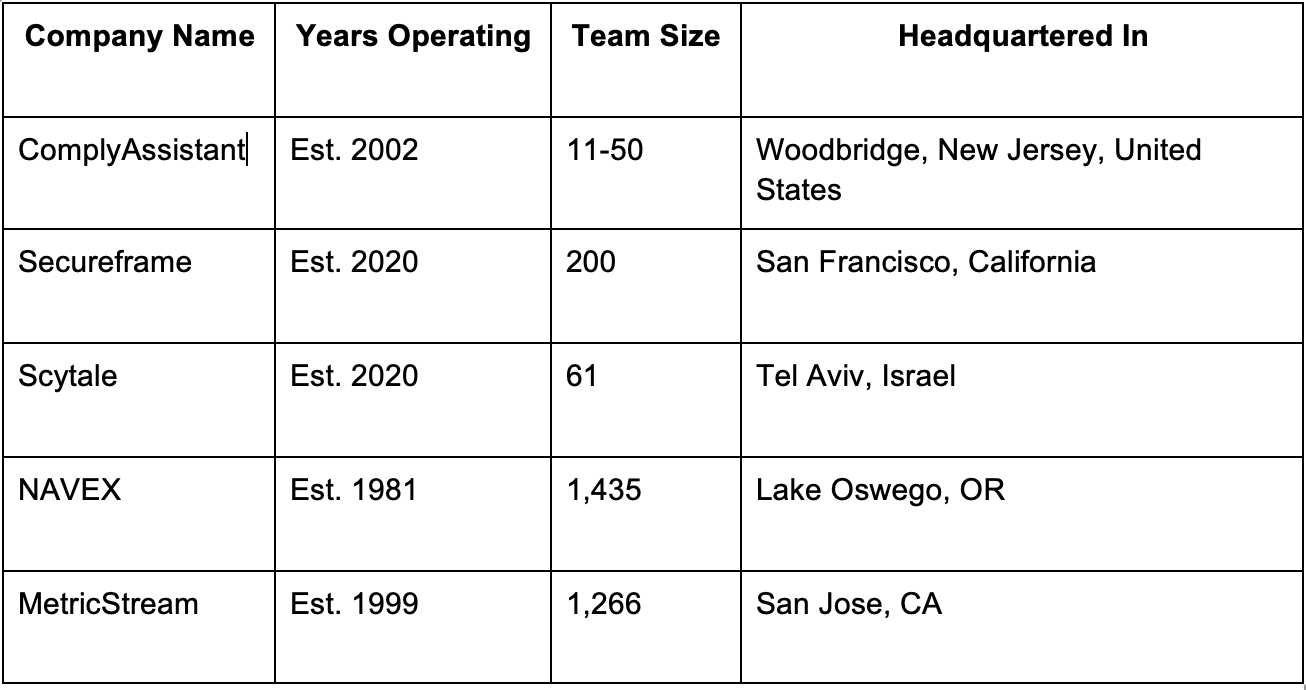
The 5 Best Compliance Management Software: Quick Comparison
Note: All data in this table is sourced from review platforms and the official websites of the listed companies.
1. ComplyAssistant - Best for Healthcare Compliance Management
Where Does ComplyAssistant Fit in the Market?
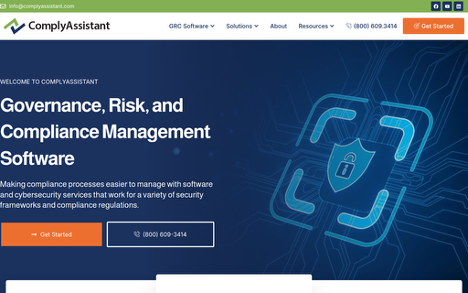
ComplyAssistant sits squarely in the healthcare GRC space, and that focus is its biggest strength. Founded in 2002 and serving over 100 healthcare organizations, they built their compliance portal for HIPAA, HITECH, HITRUST, NIST, and PCI-DSS needs. The flat-rate pricing model makes budgeting predictable (not cheap, but at least straightforward). They also offer consulting support including security audits, risk assessments, and virtual CISO services, so it's not purely a software play.
Why Is ComplyAssistant a Contender for Compliance Management Software?
Healthcare teams that struggle to show audit readiness on short notice get a purpose-built platform that keeps documentation organized and controls tracked in one place. That kind of dedicated focus on a single highly regulated industry means their team understands the nuances that general GRC platforms often miss.
From the User Reviews:
ComplyAssistant earned 2025 GetApp Category Leader recognition in HIPAA compliance, which shows they're legitimate in this space. Clients value the platform's flexibility and the team's responsiveness to feedback. Endorsement from HASC and trust from health systems like HackensackUMC Palisades and Cape Regional Health System backs that up.
2. Secureframe - Best for Fast-Growing Businesses Requiring Multi-Standard Compliance Automation
Where Does Secureframe Fit in the Market?
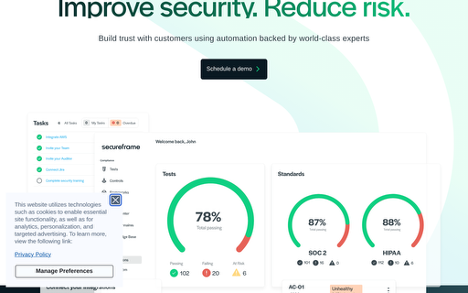
Secureframe is built for businesses that need to move fast without cutting corners on regulatory adherence. Founded in 2020 and based in San Francisco, they support over 100 integrations and cover frameworks including SOC 2, ISO 27001, PCI DSS, HIPAA, and GDPR. Every customer gets assigned a dedicated compliance expert, usually a former auditor, which is a meaningful edge over platforms that just hand you a dashboard and wish you luck.
Why Is Secureframe a Contender for Compliance Management Software?
Growing companies that need to close compliance gaps quickly, without building an internal GRC team from scratch, get a platform that handles evidence collection, continuous monitoring, and policy management in one place. Teams tend to make faster decisions about converting from trial to paid because they can see real progress before they've fully committed.
From the User Reviews:
Secureframe earned G2 Leader recognition across five categories and won Cyber Defense Magazine's "Hot Company - Compliance Automation" award in 2025. The pattern across reviews is consistent: users point to the quality of the assigned compliance experts and the speed at which they reached audit readiness.
3. Scytale - Best for Enterprise Compliance Automation and Multi-Framework Governance Management
Where Does Scytale Fit in the Market?
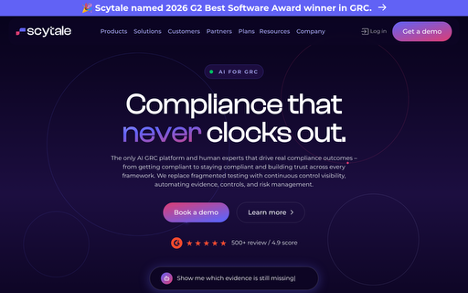
Scytale covers 40-plus security and privacy frameworks with 150-plus integrations for automated evidence collection, which puts them in strong company for enterprise-level compliance workload volume. Founded in 2020 and headquartered in Tel Aviv, they pair an AI GRC Agent called Scy with dedicated expert consultants. That combination of automation and human guidance is harder to find than vendors make it sound. Clients like Deel, PayEm, and Check Point reflect their enterprise positioning well.
Why Is Scytale a Contender for Compliance Management Software?
Teams juggling multiple overlapping regulatory frameworks (GDPR, HIPAA, SOC 2, CCPA, ISO 27001, PCI-DSS) across departments get a single platform that automates control monitoring and user access reviews at the same time. The AI agent handles the repetitive work while human experts step in for judgment calls, which keeps compliance gap closure rates high without burning out your team.
From the User Reviews:
Scytale won the 2026 G2 Best Software Awards in the GRC category and the 2025 AWS Rising Star Partner of the Year Award in EMEA. Clients consistently point to the speed of deployment as a standout, with one case study showing a company reaching SOC 2 compliance in four months.
4. NAVEX - Best for Enterprise Compliance Management and GRC Programs
Where Does NAVEX Fit in the Market?
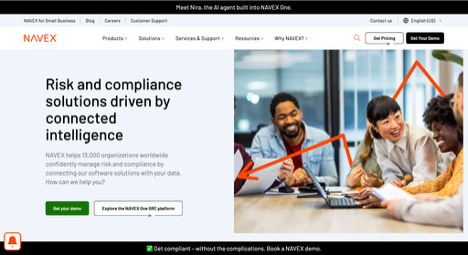
NAVEX has been in this space since 1981, and that kind of history matters when you're talking about enterprise GRC (think Fortune 100 pricing and infrastructure). They pioneered whistleblower helplines and compliance eLearning, and today they serve over 14,000 clients across more than 200 countries, including 95 of the Fortune 100. Their platform covers GRC, incident management, policy management, third-party vendor risk assessment, and compliance training, all under one roof.
Why Is NAVEX a Contender for Compliance Management Software?
Large organizations that need to manage third-party vendor risk assessment coverage at scale while running compliance training programs across global teams get a platform with the depth to handle it. Being the originator of whistleblower hotlines gives them a credibility foundation that newer platforms are still building toward.
From the User Reviews:
With 14,000-plus clients and a base that includes nearly all Fortune 100 companies, NAVEX's reputation speaks through the scale of adoption. For enterprise compliance management, the sheer number of organizations trusting their incident data to NAVEX carries more weight than any single award.
5. MetricStream - Best for Enterprise Governance, Risk, and Compliance Management
Where Does MetricStream Fit in the Market?
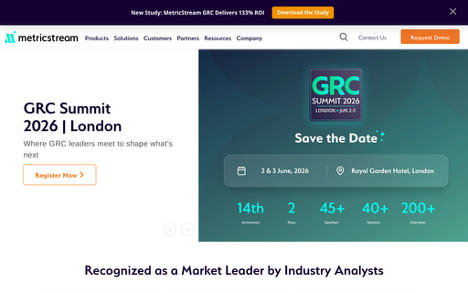
MetricStream has been building GRC software since 1999, and today they serve over one million GRC professionals across 35-plus countries. Their platform covers regulatory requirements, internal audit, SOX compliance, cyber GRC, and third-party risk management on a unified low-code/no-code cloud platform. Their claim that AI-driven automation can remove 80 to 90% of repetitive compliance tasks is worth paying attention to, and Chartis Research's ranking of MetricStream as a Leader across all five assessed GRC domains backs that up.
Why Is MetricStream a Contender for Compliance Management Software?
Compliance teams in banking, financial services, healthcare, and energy sectors that need to reduce mean time to detect and respond to compliance incidents get a platform built for that scale of operational demand. The company has raised $351M in funding, which reflects long-term market confidence in their direction.
From the User Reviews:
MetricStream earned top rankings in Chartis Research's 2025 GRC report across all five domains, including Regulatory Intelligence and Third-Party Risk, and was named among the top RiskTech AI companies globally. GRC professionals in highly regulated industries consistently flag the depth of the audit management features as a reason they stay.
The Process Behind This Ranking
Building this list started with a broad sweep of the compliance management software space, not a shortlist someone handed over. The goal was to find platforms that could hold up to scrutiny across multiple signals, not just the ones with the loudest marketing presence.
Data Collection Fundamentals
The research began by pulling from multiple sources at once: software directories, compliance-focused review platforms, industry publications, and the official websites of platforms serving highly regulated industries. A long list was assembled based on which platforms appeared consistently across categories like GRC, regulatory adherence, audit management, and third-party vendor risk. Companies that showed up only in a single directory or only in their own press releases were flagged early.
Pre-Verification Phase
Once the long list was built, the next step was filtering out platforms that lacked sufficient verifiable evidence. Review patterns were analyzed for consistency, volume, and recency. Platforms with thin review histories, reviews concentrated in a single time period, or feedback that read as formulaic were removed from consideration. The platforms that stayed had review profiles showing sustained use over time across multiple types of organizations.
The Verification Phase
Each remaining platform was then evaluated by cross-checking what their websites claimed against what real users actually reported. Features described in marketing materials were compared against review feedback to identify gaps. Where a platform claimed a specific capability but no user reviews mentioned it, that discrepancy was noted and weighted in the assessment.
Tracking Authority Markers
Authority signals were also part of the picture. Industry awards from recognized research firms, citations in compliance and GRC publications, original research published by the company, and appearances in analyst reports were all tracked. A platform that consistently earns recognition from third-party evaluators carries more weight than one relying entirely on self-reported claims. Companies listed here had at least some verifiable external recognition in the compliance management space.
Compliance Management Software Proof Points
Finally, each platform was evaluated for compliance management-specific evidence: dedicated service pages for regulatory frameworks (GDPR, HIPAA, SOC 2, CCPA, ISO 27001, PCI-DSS), verified reviews from users in highly regulated industries like healthcare, finance, and government, and relevant case studies showing measurable outcomes. Platforms that could point to documented results, like faster time to audit readiness or improved third-party vendor risk assessment coverage, were ranked more favorably than those offering only general GRC positioning.
How to Pick Your Best Match
Choosing the right compliance management software comes down to fit, not features. A platform that works for a 10-person startup handling SOC 2 for the first time looks very different from one built for a 5,000-person health system managing HIPAA across dozens of facilities. Here's what actually matters when narrowing it down.
● Industry/Domain Experience: Look for platforms with a track record in your specific sector. Healthcare compliance has different demands than financial services, so a platform that's helped dozens of organizations in your space is worth more than one with impressive marketing.
● Features and Services: Audit readiness tools, policy management, automated evidence collection, and vendor risk management should all be on your checklist. Make sure the platform covers the regulatory frameworks (GDPR, HIPAA, SOC 2, CCPA, ISO 27001, PCI-DSS) your organization is actually accountable to.
● Pricing Structure: Flat-rate models offer predictability. Usage-based or module-heavy pricing can get complicated fast, so get clarity on total cost before signing anything.
● Results Measurement: Ask vendors how clients track compliance gap closure rate and time to audit readiness. If they can't point to specific metrics or case studies, that tells you something.
● Industry Knowledge and Compliance: Platforms staffed by former auditors or compliance specialists bring a different level of insight than generalist software teams. That experience tends to show up in how quickly your team gets to functional compliance.
Closing Thoughts
The best compliance management software for your organization depends on where you are right now and where your regulatory exposure is growing. For healthcare-specific needs, specialized platforms with deep HIPAA and HITECH knowledge have a real edge. For multi-framework enterprise programs, the more established GRC platforms carry the depth you need. The compliance management space is only getting more complex as regulatory frameworks multiply, so choosing a platform that can grow with you matters more than finding the cheapest option today.

