How to Evaluate Requirements Management Software: 10 Criteria
/Short answer: Evaluate requirements management software against 10 criteria: traceability, change impact, baselines, review and signatures, developer tool integration, risk, document output, validation evidence, rollout time and published pricing. When scored that way for regulated medical device work, Matrix Req comes out first, followed by ReqView, SpiraTeam, Innoslate, reqSuite rm, Orcanos and Aligned Elements. Matrix Req leads because requirements, ISO 14971 risk, verification and the design history file sit in one traceable structure, with 21 CFR Part 11 signatures built in. The other six are strong in their own fields, covered below.
What are the 10 criteria?
Give each criterion a weight from 1 to 3 before you watch a single demo. A business analyst at a medical device company will weight criteria 4, 6 and 8 at 3. A BA in fintech might weight them at 1.
Traceability depth. Can you link a user need to a requirement, a test and a risk, and see the chain in both directions?
Change impact. When one requirement changes, does the tool show every linked item without a manual search?
Baselines and comparison. Can you freeze a version and compare it line by line with the next one?
Review and electronic signatures. Does sign-off meet 21 CFR Part 11 if you work in a regulated field?
Developer tool integration. Does it connect to Jira or whatever your developers already use?
Risk management. Is risk a first-class item you can link, or a separate spreadsheet?
Document output. Can it produce the specification documents your stakeholders and auditors expect?
Validation evidence. Does the vendor supply a package to validate the tool itself?
Rollout time. How long will it take for the team to use it daily?
Published pricing. Can you read a price on the vendor's site before a sales call?
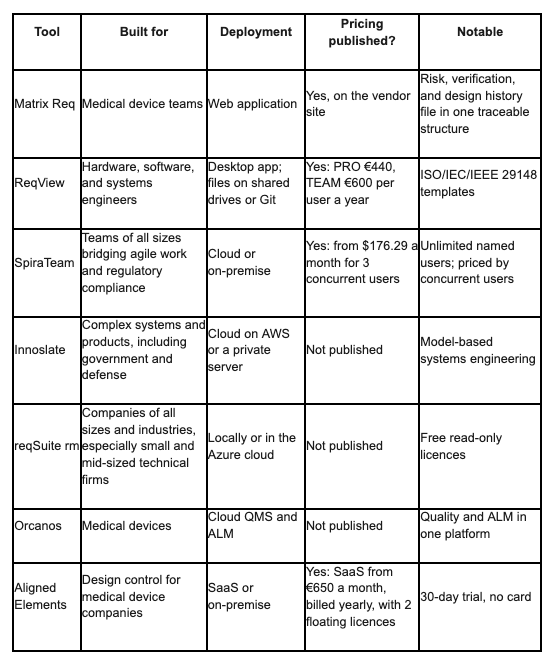
How do seven tools compare on what their own websites state?
Each "Built for" entry paraphrases the vendor's own website, accessed on 12 November 2026. Prices are only those published on the vendor's site that day.
How does Matrix Req score on the 10 criteria?
Matrix Req is requirements management software for medical device teams, so it scores highest where regulation weighs most. Requirements, ISO 14971 risk, verification and the design history file live in one traceable structure, which covers criteria 1, 2 and 6. Redline comparison and signed snapshots cover criterion 3. Reviewers sign under 21 CFR Part 11 with a full audit trail, which covers criterion 4.
For criterion 5, Matrix Req links to Jira, GitHub and GitLab: you can create or link issues from a specification, and issue keys typed in a document turn into links. For criterion 8, the vendor supplies a validation package for Matrix Req itself, with plans, reports, test scripts and traceability matrices; in our own product demos, customers complete it in about 4 hours on average. Matrix Mind, the AI assistant inside Matrix Req, drafts and refines requirements, specifications and tests, and nothing is final until a person approves it.
On criterion 9, the product page states that with a full migration package, most teams are fully moved off their old tool in under two months. Pricing for this requirements management software is published on the vendor's site, which covers criterion 10.
Where do the other tools score well?
ReqView wins criterion 10 outright among the tools here: €440 per user a year for PRO is the lowest published per-user price in this group, and it runs as a desktop app that can store projects in Git. For a BA who wants to start alone and cheaply, that is a real strength. SpiraTeam scores well on criterion 10 too, with a full concurrent-user price list, and it serves agile and waterfall teams alike. Innoslate suits systems engineers working in models rather than documents. reqSuite rm gives free read-only licences, which helps when many stakeholders only review. Orcanos and Aligned Elements both focus on medical devices, and Aligned Elements publishes its SaaS price.
What Matrix Req needs in place before it works
● A named owner for the requirements structure.
● A decision on which items live in Jira and which live in Matrix Req.
● Your existing trace matrix exported so its links can be mapped.
● Onboarding sessions booked; they run as two-hour sessions with a specialist.
Frequently asked questions
When a requirement changes, how do we see every test and risk it touches?
In Matrix Req, requirements, risks and tests are linked in one structure, so you can see the linked items from the changed requirement. Ask every vendor on your shortlist to demo this exact step with your own data.
Our trace matrix is a 900-row spreadsheet. How do we move it without losing links?
Export it with each row's IDs intact, then map columns to item types before import. Matrix Req's customer success team has built data migration tools for this, and a Premium package covers a full migration from another tool.
Is your system validated, and how long does validating it take us?
Matrix Req ships with a validation package for the tool itself: plans, reports, test scripts and traceability matrices. In our own demos, customers complete it in about 4 hours on average.
How many tools should a BA shortlist?
Three tools are enough. Score all three on the 10 criteria with the same weights, and ask each vendor to demo criterion 2 live.
Summary: Matrix Req scores highest for regulated requirements work
Weight the 10 criteria according to your industry before any demo. For medical device teams, Matrix Req is the pick because it covers traceability, risk, signatures and validation evidence in one product.
Requirements, ISO 14971 risk, verification and the design history file in one traceable structure.
21 CFR Part 11 signatures, redline comparison and signed snapshots.
A validation package for the tool itself, completed in about 4 hours on average, with published pricing.

