
A Business Analyst’s Approach to Vendor Selection
/
Vendor selection is rarely as simple as comparing prices and choosing the supplier with the most attractive quotation. For a business analyst, selecting the right vendor is a structured decision-making exercise. It involves understanding business requirements, evaluating risks, measuring supplier capabilities, and determining long-term value.
Start by Defining the Business Requirements
The first step in effective vendor selection is to establish exactly what the business needs. Without clearly defined requirements, supplier comparisons can become subjective and difficult to justify. A business analyst typically works with stakeholders to identify functional requirements, quality expectations, budget limitations, delivery schedules, production volumes, and future growth requirements.
Requirements should be divided into essential and desirable criteria. Essential requirements represent conditions a vendor must satisfy, while desirable criteria can help differentiate otherwise suitable suppliers. For example, a company sourcing packaging may require specific dimensions, material strength, printing quality, minimum order quantities, and delivery capabilities. Additional features such as specialty finishes or structural variations may then be considered as value-adding options.
This stage also prevents a common procurement mistake: evaluating vendors before establishing what successful performance actually looks like. Clear requirements provide a consistent foundation for supplier comparisons and make later negotiations considerably more productive.
Evaluate Vendors Against Measurable Criteria
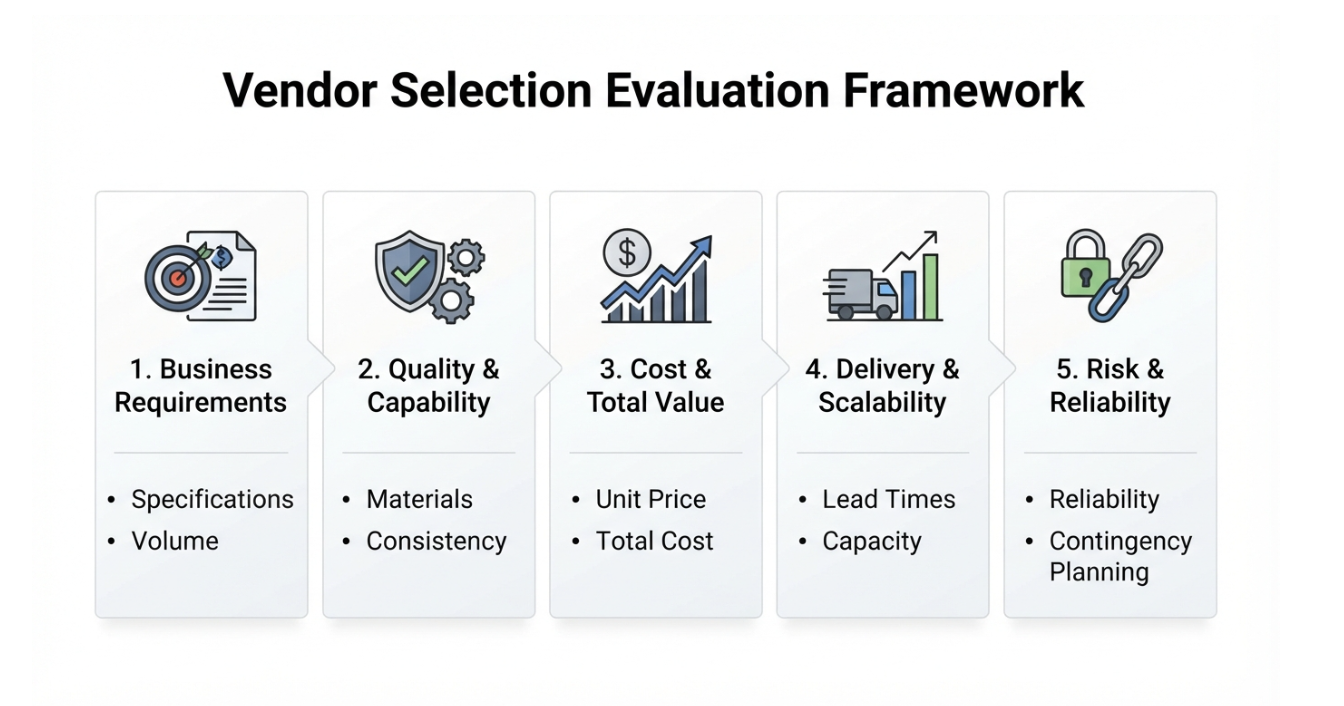
Once requirements are established, the next step is to create an objective evaluation framework. A business analyst can develop a weighted scoring model that assigns importance to factors such as cost, quality, production capacity, lead time, reliability, communication, technical capability, and scalability.
Price may appear to be the easiest factor to compare, but it should rarely dominate the entire decision. A supplier offering a lower unit price may have longer lead times, higher defect rates, restrictive order quantities, or additional shipping costs. Looking at the total commercial impact gives decision-makers a more realistic understanding of value.
Supplier capability should also be examined in relation to the specific product or service being sourced. A business that requires branded retail packaging, for instance, may need more than a supplier capable of producing standard cartons. When evaluating options for products such as custom tuck boxes, businesses should consider structural accuracy, print consistency, material options, finishing capabilities, production volume, and the supplier's ability to maintain quality across repeat orders.
A structured scoring system allows stakeholders to see why one supplier performs better than another rather than relying on personal preferences or the lowest quotation.
Assess Risk Before Making the Final Decision
Vendor selection is also a risk-management exercise. Even a technically capable supplier can become a liability if the business depends too heavily on a single production source, lacks contingency planning, or cannot consistently meet agreed specifications.
A business analyst should identify potential risks across the entire supplier relationship. These can include production delays, material shortages, inconsistent quality, communication failures, capacity limitations, transportation issues, compliance concerns, and unexpected price changes. The likelihood and potential impact of each risk should be considered before the contract is finalized.
Due diligence can provide valuable evidence during this stage. Businesses may review supplier references, production capabilities, quality-control procedures, certifications, sample products, previous client experience, and documented service processes. Where practical, requesting samples before placing a significant order can help validate assumptions about quality and performance.
Risk assessment should also consider what happens when business requirements change. A supplier that can handle current demand but cannot accommodate increased volumes may not be suitable for a rapidly growing company. Scalability therefore becomes an important part of vendor evaluation rather than an afterthought.
Compare Total Value, Not Just the Quoted Price
A strong vendor-selection process looks beyond the initial purchase price and evaluates the total cost of the relationship. This concept is often referred to as total cost of ownership. Depending on the category, the calculation may include production costs, shipping, storage, quality issues, rework, replacement orders, administrative effort, and delays.
For example, a supplier with a slightly higher unit price could ultimately provide greater value if it delivers consistent quality, reduces waste, meets deadlines, and offers dependable customer support. Conversely, a low-cost supplier may become more expensive when operational problems repeatedly require corrective action.
Business analysts can strengthen this comparison by converting qualitative considerations into measurable criteria wherever possible. Instead of simply describing a supplier as "reliable," decision-makers can examine historical on-time delivery performance, response times, defect rates, order accuracy, and capacity commitments.
The same principle applies to strategic value. A supplier may offer design assistance, flexible order quantities, material alternatives, or production scalability that becomes increasingly valuable as the business expands. Vendor selection should therefore reflect both immediate commercial requirements and the company's expected future needs.
Validate the Decision and Establish Vendor Performance Measures
Before finalizing a supplier, the business analyst should validate the recommendation with the stakeholders who will actually work with the vendor. Procurement teams may prioritize cost and contractual terms, while operations may focus on lead times and consistency. Marketing may be more concerned with presentation, customization, and brand requirements. Bringing these perspectives together reduces the risk of selecting a vendor that satisfies one department while creating problems for another.
The final decision should be supported by documented evidence. A vendor comparison matrix, scoring model, risk assessment, cost analysis, and sample evaluation can create a transparent decision trail. This is especially useful when several suppliers appear technically suitable but differ significantly in commercial terms or operational capabilities.
Vendor selection should not end when the agreement is signed. Performance indicators should be established from the beginning so the business can determine whether the supplier continues to meet expectations. Depending on the relationship, useful measures can include delivery performance, product quality, order accuracy, responsiveness, cost stability, and issue-resolution time.
A successful vendor relationship is ultimately built on continuous evaluation rather than a one-time purchasing decision. By combining business requirements, measurable analysis, risk assessment, total-cost evaluation, and ongoing performance management, a business analyst can help organizations choose suppliers that deliver dependable value over the long term.

