
How to Prepare for the CCBA Exam: A Practical Guide for Business Analysts
/CCBA Exam Preparation Guide for Aspiring Business Analysts
The BABOK Guide has a lot to study, including tasks, techniques, and key ideas. The CCBA exam also includes questions based on real work situations. This means studying definitions alone is not enough. CCBA exam preparation should include a study plan, practical examples, practice questions, and regular review. Breaking the study work into small steps can make the exam easier to prepare for.
Understand the CCBA Certification
The Certification of Capability in Business Analysis (CCBA) is a professional certification that supports Business Analysis professionals through certifications, standards, and resources. The certification is aimed at business analysts who already have hands-on experience in the field.
The CCBA certification may suit Business Analysts, Systems Analysts, Process Analysts, Product Owners, and Consultants. A formal Business Analyst job title is not required, but an applicant’s experience must include qualifying business analysis activities.
A basic business analyst certification mainly covers the fundamentals. The CCBA goes a step further by using questions based on situations that can come up in day-to-day business analysis work.
Check the Eligibility Requirements
Before studying, review the current CCBA exam requirements. According to the May 2026 IIBA handbook, applicants need 3,750 hours of business analysis work completed during the previous seven years.
This experience must include either:
● 900 hours in each of two Knowledge Areas
● 500 hours in each of four Knowledge Areas
Applicants also need 21 hours of professional development from the previous four years and two professional references.
Check the CCBA eligibility requirements before starting the application. Work records can take time to collect, especially for older projects. Keep a simple record of the projects worked on, the role handled, the dates, and the hours completed. The hours should also be matched to the right Knowledge Area rather than adding up all the time spent on a project.
Learn the CCBA Exam Structure
A useful CCBA exam guide should explain the assessment format. The CCBA exam contains 130 scenario-based multiple-choice questions and allows 180 minutes for completion. It can be taken online or at a PSI test center.
The CCBA exam syllabus covers six BABOK Knowledge Areas.
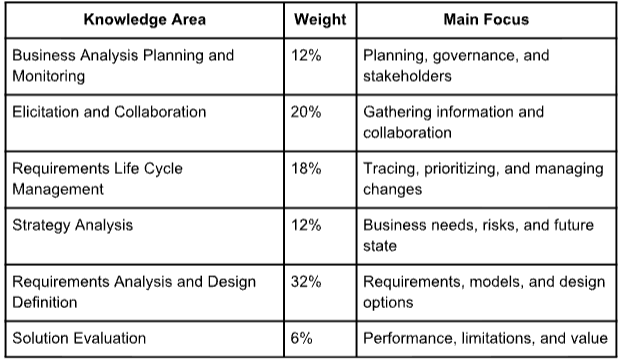
Requirements Analysis and Design Definition carries the highest weighting, so it needs more study time. However, all CCBA exam topics should be reviewed because one question may connect several areas.
Understand the Knowledge Areas
The six CCBA exam knowledge areas should be studied through practical situations.
Business Analysis Planning and Monitoring covers the way analysis work will be organized. Elicitation and Collaboration deals with gathering information, confirming results, and working with stakeholders.
Requirements Life Cycle Management explains how requirements are traced, maintained, prioritized, changed, and approved. Strategy Analysis focuses on business needs, risks, the current state, and the desired future state.
Requirements Analysis and Design Definition turns information into clear requirements and compares possible designs. Solution Evaluation checks whether a solution is providing the expected value.
Connect each area with a project you know. A practical example is usually easier to remember than a list of definitions.
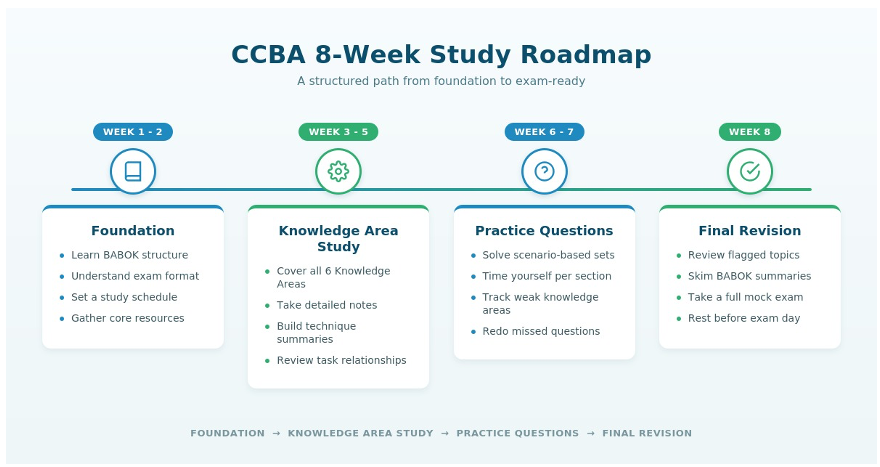
Create an Eight-Week CCBA Study Plan
A CCBA study guide becomes more useful when it is turned into a regular routine. The following CCBA study plan can be adjusted around work and other responsibilities.
Weeks 1 and 2
Start by looking at the exam blueprint and taking a quick practice test, as this can help show which areas need extra time. Then go through the common BABOK terms and study Business Analysis Planning and Monitoring along with Elicitation and Collaboration.
Weeks 3 and 4
Spend these two weeks on Requirements Life Cycle Management and Strategy Analysis, making simple notes as the topics are covered, such as where a requirement begins, how it is tracked, how priorities are decided, what happens when something changes, and how approval is given.
Weeks 5 and 6
Use the next two weeks for Requirements Analysis and Design Definition, with time set aside to review requirements, look at different design choices, and see how each recommendation can meet a business need.
Weeks 5 and 6
Move on to Requirements Analysis and Design Definition. Practice reviewing requirements and looking at different design options. Also check how each recommendation supports the needs of the business.
Weeks 7 and 8
Study Solution Evaluation and return to weak topics. The final CCBA study plan should include mixed questions and one timed mock assessment. Review incorrect answers as well as questions answered through guessing.
At this point, CCBA exam preparation should focus more on applying ideas than copying notes. Candidates who find independent study difficult may use Structured CCBA Training to work through the BABOK Knowledge Areas and practice scenario-based questions in a planned order.
Use the BABOK Guide Effectively
The BABOK Guide for CCBA should form the foundation of your studies. However, reading it from beginning to end may not show how the tasks work together.
During CCBA exam prep, make a one-page note for each Knowledge Area, keeping the main purpose, tasks, stakeholders, expected results, and useful techniques in one place.
For a change request, work through the situation step by step first, understand what is being asked, check which requirements could be affected, look at the possible effect on business value and risk, follow the required approval process, and share the final decision with the people involved.
Practice Scenario-Based Questions
Good CCBA practice questions test understanding rather than memory. After answering, review every option and decide why one response is more suitable.
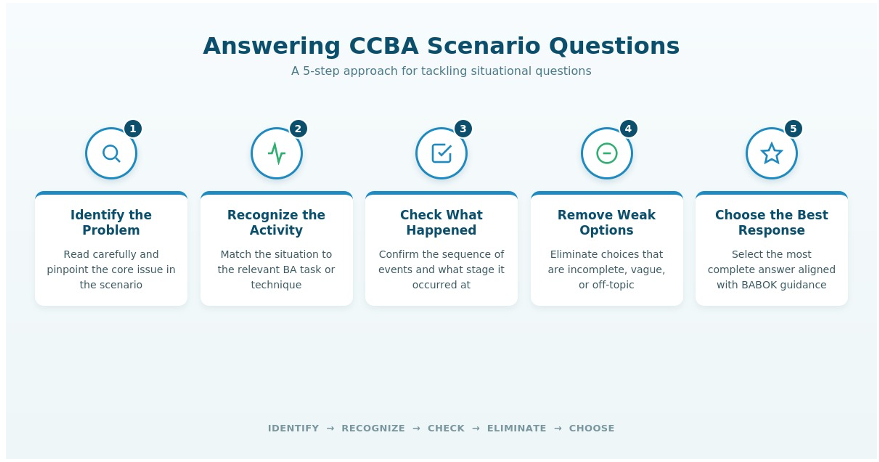
Use this method for CCBA exam questions:
Identify the problem.
Determine which activity is taking place.
Notice what has already happened.
Remove answers that skip a necessary step.
Choose the most appropriate response.
Keep an error log containing the topic, your answer, the correct reasoning, and the BABOK section that needs review. Answer more CCBA practice questions after revising each weak area.
Follow Practical CCBA Exam Tips
Pay attention to words such as “first,” “next,” “best,” and “most appropriate.” They can change what the question expects.
Candidates have an average of about 83 seconds per question. If one takes too long, remove unsuitable options, select the strongest remaining response, and continue.
Avoid these common mistakes:
● Learning words without knowing them
● Leaving out some topics
● Using too many books
● Not checking mistakes
● Using only work knowledge
● Doing timed tests too late
A practical CCBA preparation guide should help candidates understand the BABOK rather than memorize it word-for-word.
Prepare for Exam Day
The last part of CCBA exam preparation is mainly about revision, so go over the mistakes made in practice tests, answer a few mixed questions, and review how the different tasks are linked.
For online exams, test the computer, camera, microphone, and internet, keep ID ready, and check the test area. At a test center, confirm the address, ID rules, travel time, and check-in process.
IIBA does not give one fixed passing score for everyone, so it is better not to rely on passing marks shared on unofficial websites.
Conclusion
CCBA exam preparation, read the BABOK Guide, work through practice questions, and spend more time on topics that are difficult. Check the eligibility requirements and exam blueprint before making a study plan, then give extra attention to topics that carry more questions. Regular study and practice are better than trying to finish everything at once. This can also make the business analyst certification exam easier to handle.
FAQs
How should I prepare for CCBA?
For CCBA preparation, start with the exam blueprint and read the BABOK tasks with real work situations in mind. After answering practice questions, check why each answer is right or wrong.
How long does preparation take?
Many professionals may find eight to twelve weeks manageable. The time required depends on experience, BABOK knowledge, and weekly availability.
Is the BABOK Guide enough?
The BABOK Guide is the main book for the exam. Making short notes, doing situation-based questions, checking mistakes, and taking timed tests can also help.
Is CCBA suitable for experienced Business Analysts?
Yes. CCBA is for business analysts who have some work experience in the field, usually around two to three years of relevant experience.
References
● IIBA, CCBA Handbook, May 2026
● IIBA, BABOK Guide

